
نتواصل لأجل أطفال سعداء
We Communicate For Happy Children
We Communicate For Happy Children
 Youssef One of… “Mankind’s Beautiful Names” (Zahi Azar/ SWANA Region)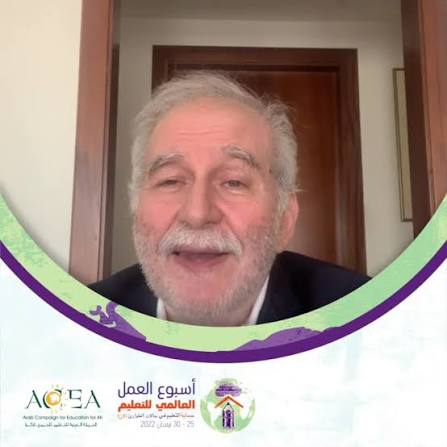
Dr. Zahi Azar/ Southwest Asia and North Africa Region: President of the Arab Campaign for Education for All, and Head of the Arab Network for Popular Education.
9 October 2026
I did not realize Youssef held such a place in my heart until I was devastated by the news of his leaving this world.
Youssef was never like the others. His presence was unique, imbued with an attractive serenity that drew everyone living amidst the noise around him to meet and get to know him. It is said that he possessed a radiant charisma. Youssef was unlike anyone else.
These are the impressions that began to surface in my heart after I was shocked to learn that he had left us…
Those who closely knew Youssef gradually came to know a person who did not like to reveal his innermost thoughts, his strengths, or his feelings. Youssef was always inclined towards silence, and it was rare for such profound human and spiritual depths to be unveiled.
His love touched you from the moment you met him. Youssef was distinguished by his ability to attract and care for everyone, friends and strangers alike. Every person he met felt his warmth and affection, cherished the time they spent together, and always hoped for another encounter.
Youssef rarely spoke about his personal, spiritual, intellectual, and human history, which was founded on a solid Christian faith. His faith evolved until he internalized the importance of encountering others, whether Christian, Muslim, secular, or of any other religion.
People sensed Youssef’s rich cultural, spiritual, and intellectual depth. He found greater comfort in expressing this richness through writing, which gradually led him to commit to the Arab Resource Collective (ARC) for many years.
At his core, Youssef rested on a solid foundation of faith that had grown and developed throughout different phases of his life. He found himself close and committed to many personalities and individuals, devout and secular Christians, searching for deeper dimensions of commitment.
Youssef was active in the “Association of Committed Christians” before the outbreak of the Lebanese Civil War. He then became involved in ecumenical work in Lebanon, eventually becoming associate general secretary of the World Student Christian Federation (WSCF), based in Geneva. He remained in this position interacting with his convictions, influencing and being influenced by this student group whose members, for the most part, had a tangible impact during that period, both within and beyond the church.
During his years living outside the Arab region, Youssef carried his Eastern identity and Arab Christian ethics to the circles of testimony in this world. He both taught and learned amidst the various events and commitments he experienced. He then returned to Beirut, where he served as the regional secretary of the WSCF amidst the war in Beirut and other parts of Lebanon.
Youssef held the cause of preserving the WSCF historic office in Ras Beirut, not only as a landmark but also as a vibrant site for encounter and dialogue, amidst the military and political confrontations, the wars, and the frenzy of sectarian and factional belongings.
Youssef relatively succeeded in addressing this challenge. The place remained a testament to the depth of his will and the sincerity of his commitment: to meet and engage in dialogue with others, all others.
However, Youssef was unaware of the price he would pay. He was repeatedly threatened and forced from his home amidst the ravages of war and ongoing conflicts. Nevertheless, throughout this period, he preserved the site and its Christian symbolism, wanting it to remain present, a witness, a participant in dialogue, and an active force amidst all that was happening, both on a personal level and on a national level. The office remained, in Youssef’s image, a center for meeting and dialogue for everyone, silently and humbly defying all that was unfolding.
Youssef Hajjar embraced this cause, raising it defying the war.
In his interaction with his convictions and the uniqueness of his personality, he remained focused on the importance of committing to others, gradually becoming an advocate of rights and contributing to numerous activities and projects in a country constantly searching for its identity.
In the midst of all this, an artistic dimension blossomed in Youssef, and he developed it with remarkable simplicity and modesty. He began to sing and strum the oud, mastering many songs and melodies. This dimension was integrated with his love of meeting people, engaging in dialogue, and expressing himself eloquently.
This dimension was also intertwined with several of his convictions. He sang the songs of Sheikh Imam and other singers from the golden age of Arabic music, performing them with mastery. Whether consciously or not, he used this to solidify his Eastern and Arab identity, especially that he silently spoke through his music of his belonging to the Damascene spirit where he grew up and learned a lot. He would always look back with sorrow and some sadness to where he was raised.
This dimension was further enriched by his Eastern Christian identity, which had been beset by numerous challenges and setbacks. Despite everything, Youssef sang and strummed the oud for the loved ones, the country, and the future.
Youssef, in expressing his belonging, remarkably excelled at reciting “God’s Beautiful Names”. Everyone would always ask him to recite them at any meeting, gathering, or session, and he would do so joyfully with “tajweed”, sometimes holding his prayer beads, other times wearing his dishdasha, his face radiant with love and an embracing smile.
Beloved dear Youssef is leaving us, but he remains alive somewhere very strongly in our hearts. Abu-l-Zouz excelled in “God’s Beautiful Names” for which he was known, but he remains in our hearts and the hearts of many others as one of “Mankind’s Beautiful Names”.
May his memory be eternal.
