
نتواصل لأجل أطفال سعداء
We Communicate For Happy Children
We Communicate For Happy Children
 Tribute to Emad Tharwat Khalil by Youssef Hajjar (2017)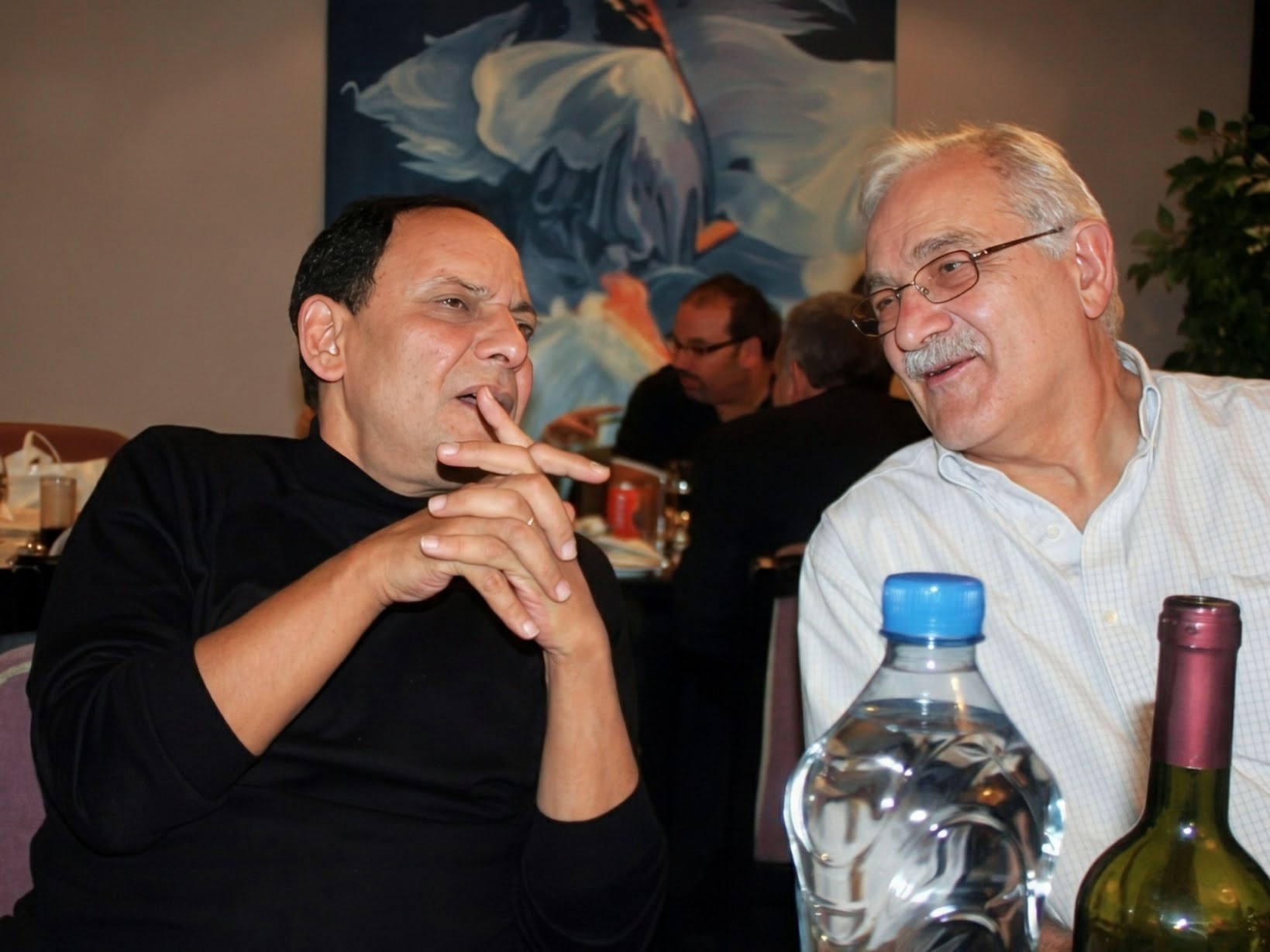
On Sunday 22 October, our colleague Emad Tharwat Khalil (1953-2017) passed away unexpectedly. Emad was born in Minya in Upper Egypt. Educated at the Jesuit school there, he later acquired a BS in agriculture. Early on in his professional life, he worked for long years at the Upper Egypt Association for Education and Development, mostly in youth activities and in a popular education programme based on Paulo Freire’s approach to adult education. At the same time, he developed a deep belief in the need for participatory practices in the management and governance of civil society organisations. This inspired him to launch the Salama Moussa Association with a group of colleagues who shared his convictions. At the same time, he set up Ro’a Company for Consultancy and Training, which was his channel for professional work in social development in Egypt and other Arab countries, with governmental departments as well as with UN and non-governmental institutions.
Emad was an activist for social transformation, working directly with the people, particularly the young and the children, and aiming at building active citizenship based on the concept of rights. For example, he used various methods to promote, disseminate and implement the Convention on the Rights of the Child. He used to say: “children and young people are the main resources of our society. It’s the duty of governments to ‘spoil’ them and invest in building their capacities, as a first priority”. He produced himself and contributed to the collective production of many educational and training resources. One of his recent works was the “Testimonies of Women and Girls”, from interviews with women participating in the revolution of Tahrir Square in Cairo, an approach which is perhaps the most illustrative of his understanding of activism. We have also to mention here that Emad was a trustee of the Arab Resource Collective since its inception in 1989 and had a distinct role in its development, both at the level of its vision and governance, and through the elaboration and implementation of its programmes.
Emad may not forgive us if we failed to mention that he was also an ardent performer of Sheikh Imam’s songs and a competent drummer: he filled our evenings in workshops with joy and excitement. Emad departed before his time and left in the thoughts of those who love him, and they are many, a very big void. But our warm memory of him is nurtured by the traces of his work that we read wherever we look, in the resources we use as well as in the brightest facets of our work’s impact.
I wished I was with you when you celebrated the life of our Omda (mayor), Emad, and you reminisced about how much we loved him and enjoyed his company.
I have known Emad since the 1970s. I may well have been the first in our group to meet him! The first encounter engraved in my memory took place in Ayia Napa, Cyprus, in 1978. We were at the old monastery for a workshop aimed at developing a popular education program based on Paulo Freire’s approach to adult learning. The program was an initiative of the World Student Christian Federation, led by Tarek Mitri, WSCF coordinator for the Arab region at the time. We were joined at the workshop by figures such as Bishop Gregoire Haddad, Sister Nabiha Afif, Albert Abi Azar, and Mohammad Hajjar, as well as Samir Saad from Egypt (three of whom have since passed away!). On the first evening, we gathered in a circle outside the meeting room, the bishop asked me to sing, and I did for nearly half an hour. When I paused for a moment to choose the next song, Emad spoke up: “Youssef, do not stop. We are getting cold!” At least, this is how my memory chooses to record the anecdote… What were the main songs? Naturally, Sheikh Imam and some of Fairuz’s patriotic songs. Tarek Mitri who used to visit Cairo as part of his duties would attend the singing sessions of Sheikh Imam and Ahmed Fouad Negm, along with others who happened to be there. (If I am not mistaken, Ghassan was sometimes there, as he was studying medicine at Cairo University at the time, noting that we did not know each other back then.) Tarek brought us two cassettes that were primitively recorded, yet sufficient to introduce us to the world of Negm and Imam, a world striving for justice through poetic and musical expressions that stirred our spirits and fueled commitment. I mention this to recall that, in the years that followed, Emad launched a choir that made Sheikh Imam’s songs an integral part of its repertoire.
During one of my visits to Egypt, after I had settled into the role of WSCF coordinator at Al-Makhoul Street center in Beirut, succeeding Tarek Mitri in 1982, I accompanied Emad to meet some young people in Minya. There, he took me to visit a retired Oud player who crafted instruments for sale. Emad used to call him Uncle “So or So” (I no longer recall the name), and he would visit him regularly to look after him and learn from his expertise. The man asked me what I sing, then he played, and I accompanied him on passages from “Ya Jarat al-Wadi” (Neighbor of the Valley). Encouraged by Emad, I bought a simple Oud from him, the one that he had recommended for its sweet resonance, and I brought it back with me to Beirut. By the way, we must not forget that Emad was a first-rate “Darbuka” player (as was Ghanem), and he often brought fun and high spirits to our evenings. Conversely, I never quite mastered the Oud as Emad had hoped I would, and my renditions of Sheikh Imam’s songs remained entirely unadorned!
To continue the story of the Oud, after acquiring an older instrument, I gave the Minya Oud to Kamil Barakat, a young man from Mashghara full of hope and longing to master singing, particularly Byzantine chanting. One day, Kamil traveled to his hometown in the Bekaa Valley to help in a reconciliation between local families, only to vanish without a trace. That was in 1983 or 1984. Kamil who left us far too soon was among the many circles that intersected during the Israeli siege of Beirut in the summer of 1982. Of course, Ghanem Bibi and Ghassan Issa were also to me within those circles.
During another visit to Egypt (these trips took place between 1983 and 1986), Emad took me to meet Ahmed Abdullah (who has also passed away, leaving a deep sadness in Emad’s heart). Emad held for Ahmed a mix of affection and high regard, often seeking him out to exchange analyses and ideas, renew his vision and understanding of commitment, and occasionally engage in “teasing”. Ahmed was affectionately sarcastic about Emad’s involvement in civil society work, urging him instead to pursue direct political action. Naturally, as we all know, that did not deter Emad from his chosen path. He was convinced it was the best way to remain close to people, especially the youth, and to work directly with them in order to foster awareness and knowledge and drive positive change, eventually leading to political engagement at the right time and in the right form. By the way, during that period, he was boldly campaigning within the Upper Egypt Association to introduce participatory practices, challenging the unilateral decision-making of a leadership entrenched in power.
When we launched the Arab Resource Collective in the late 1980s, it was only natural to invite Emad to help build it, both through the Board of Trustees and via specific projects. By then, he had already founded Ro’a and Salama Moussa…
In our Popular Education project during the 1980s and later in the Training for Transformation project within ARC, we adopted Sheikh Imam’s song “Al-Tanbour” (The Water Wheel) as our anthem: “If you are wise and have grasped the message, then explain it, my son, to those who haven’t. It’s simple: Lift the water, spin and turn, oh Tanbour! Gather a little, let the water irrigate the barren land, oh Tanbour!”
Emad with his Upper Egypt determination and innate common sense, the seasoned practitioner intellectual who wore his knowledge lightly, was the embodiment of the “Tanbour”: he lifted the waters of knowledge to irrigate the barren soil, quenching its thirst for growth and productivity.
Emad, our Omda, you had no right to leave us so prematurely. So many of us miss your insight and your warm presence. I had been looking forward to a long conversation with you at the ANECD meeting in Amman, as many questions weighed on my mind regarding the value of our efforts over the years, particularly concerning the ARC trajectory, strategies, and governance, as well as our individual and collective responsibilities for its future. Circumstances over the past few years have prevented us from meeting regularly, and now you left us. You remain vividly in my thoughts, Emad, and the affection I hold for you is etched as deeply as the years of our shared endeavor.
